Business, Online Business

Instagram: 7 tips for good self-marketing

You don’t always have to become an influencer to use Instagram successfully for self-marketing. How to make your expertise visible and expand your network.

The world of influencers is immensely seductive. Range. Notoriety. Maybe earn a little more money … But if you look at the one billion users that Instagram currently has every month, very few make it to influencers . Not everyone is made for it or wants to. And yet this influencer claim always somehow hovers over us when you want to be there on Instagram. It is not necessary to have thousands or hundreds of thousands of subscribers to use Instagram successfully. Even on a small scale, there are opportunities to establish yourself as an expert and to take your own self-marketing to the next level.
Good content. Regular content. Use insights. That is the basis of professional self-marketing on Instagram. But what if even hashtags, videos and stories don’t work and Instagram just swallows everything like a deep black hole and nothing moves? Then it’s time to tweak a bit. Here are a few tips on how to get even more out of your self-marketing on Instagram.

1. Instagram as a portfolio

Many think they have to keep up with influencers on Instagram and post lots of private or particularly lifestyle pictures. It is not uncommon for this to work with more moderate success. If you want to use Instagram for self-marketing, you should be clear about what the goal is. I want thousands of subscribers? Do I just want to use Instagram for fun? Or do I want to specifically show my expertise and become an ambassador for myself and my topic? Of course, personality is important on Instagram. But it shouldn’t take over the whole account. What do you think a potential customer or employer can expect when they find a link to your Instagram account on your professional website? Just because it’s Instagram doesn’t mean the expectation is any different than on other platforms. The 20 pictures from the last Bali vacation are really amazing. And all the selfies are really nice too. But what does that say about you and your know-how? I clearly admit your expertise: Show what you know, what you do and how you do it. Anyone who finds you on Instagram should be able to see just that right away.

2. Your username on Instagram

Your username is one of the most important levers for self-marketing on Instagram. Because it determines your Instagram handle (@yourinstagramusername), your Instagram address (instagram.com/yourinstagramusername). Your username should therefore not be too long or complicated to be easy to remember. Your real name can be a way of doing this. But a combination of your name and your job is also a good choice. A private label, on the other hand, is more worthwhile if you have a comprehensive concept with further strategic communication points – for example YouTube or blog.

3. Optimize your Instagram name

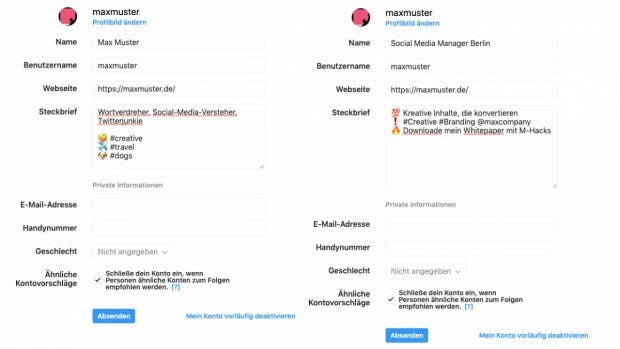
Go to Instagram’s profile search and search for your topic, your job, your expertise. Are you found here? The likelihood is high that it isn’t. Because often important keywords are not included in the username. And certainly not in the name. But Instagram is currently only searching these two fields for the profile search. So what to do Just customize your name. This is located in bold under your profile picture and can be changed as often as you want via Edit profile. The only drawback: Instagram only allows 30 characters for your name. However, this is often enough to place your industry or other keywords here. Now you will be found in the Instagram search and your keyword will be displayed under your username. And also with search engines you will be indexed and found with it. That may not be entirely in the true sense of Instagram. But there is nothing against it in the terms and conditions and community guidelines – especially since there is no real name requirement on Instagram.

4. Use your Instagram bio

The profile is also often neglected on Instagram. Many enter a short bio in key words, their private interests or hashtags. But the Instagram bio can do so much more than just that. Make targeted use of the profile to tell us what you do and what you offer. Your Instagram bio will be perfect with a call-to-action. You can call up to visit a website, an event or download a PDF that you link below. Of course, you can also link other professional profiles. You have 150 characters for your Instagram bio. Use it!

5. How was that with links?

Instagram is struggling with links. If you don’t have at least 10,000 subscribers or are verified, you cannot insert links directly into stories. And also in the profile there is only space for a single link. That is why many Instagrammers use tools such as Linktree as “mini landing pages”. Here you link individual content as well as the imprint. You can do that too. And sometimes that’s a good solution too. But if you already have your own, mobile-optimized, fast website – why this detour? Every additional click also means the possibility that interested parties will jump off. Instead, build a landing page on your own website. This is how you draw interested parties directly to your page. Here you can not only determine what you want to show, but also how.

6. Regional placement

Content from the environment is not only pushed on Facebook. You can also position yourself better on Instagram if you rely on regional content. Whether in posts, stories or live streams – use the location function of Instagram for more reach and targeted targeting. Remember: smaller locations are often more successful than large ones, e.g. Hanover instead of Germany. As a freelancer, it can also make sense to include your location as a keyword in your name. Many rely on regional experts. So what reason should there be not to find you there? The location function is still used far too little – especially in stories. So better chances for you.

7. Find a partner

Networking and engagement are big topics on Instagram. It is therefore worth investing some time in finding partners. These can be people who deal with the same topic as you. But they can also be related topics. In this way, you can complement your content, expand your skills – for example with joint live streams in Instagram stories. This not only increases your visibility immediately, but also places you in a professional environment with other experts. Such cooperation – not least through agencies – has long been proven on YouTube. On Instagram, many still rely exclusively on classic tagging – if at all. There is still a lot of room for improvement.

Business

How to increase the response rate to online surveys

The response rates to online surveys have fallen across all industries since the introduction of the GDPR , in some cases by half. What can companies do to increase it? Here you will find eight practical tips.

1. Tell everyone: we’re starting a survey!

In many companies, online surveys run “on the side”. Few of the potential attendees and staff know they are taking place. Communicate the survey like a big new project. This will prepare the participants and your colleagues for it – and arouse their curiosity:

  • In the newsletter , in social media and on the website, you explain why the survey is taking place and what your aim is (for example to improve products and services or to find out the latest opinions on a topic). Include a link to the survey or a login option. Explain what benefits the participants have: They gain new insights, can influence the development of your products or the service of your company is improved.
  • School all employees who have contact with the potential participants (salespeople, account managers or call center agents): they should bring up the survey every time they meet and explain the benefits of participating.
  • Put a brief note in your email signature four to six weeks before the survey. You can link to the blog article about the survey with the words “Why your opinion matters – find out”.

2. Send advance notice and arouse curiosity

Send an advance notice two to three days before the survey. In it you draw the participants’ attention to the survey and name the goal. An example:

  • “Hello Max, here at ABC GmbH we are introducing a short survey on customer satisfaction. With it you can tell us in a few minutes what is most important to you when working with us. Check your inbox for the invitation in the next two days. We look forward to hearing from you!
    Tina Musterfrau, CEO of ABC GmbH “
  • Use a clear subject, such as “Announcement: Tell us what you really feel”, “Coming soon: Survey on topic XY”.
  • Be brief and keep a consistent layout for the advance notice, survey, and invitation.

3. Personal addressing of each participant

As with sending newsletters, the same applies to online surveys: a personal approach ensures a higher opening rate and more participation. Write “Dear Ms. Mustermann” or “Hello Tim” instead of “Dear participant” or “Dear customer”.

Important when addressing the question personally: If you evaluate the survey anonymously, write it down. Otherwise the impression could be created that the answers are linked to the name. For international participants, send the survey in the appropriate language and also translate the invitation.

4. CEO as the sender

An email from Steve Jobs in your mailbox? You probably wouldn’t have hesitated for a second to read it. A message from Apple support or from “Steven from Market Research”, on the other hand, is less exciting. You can use this effect in surveys: The invitation to participate should come directly from your CEO. Insert – after prior agreement – his signature and his signature. On the website you can insert a statement from the management about the survey with a portrait photo. This underlines how important the survey is for your company. You arouse interest and motivate people to participate.

5. Don’t ruin your response rate yourself

You may know that: When you stayed at a hotel, you were annoyed by a bad breakfast buffet. You fill out an online survey on the booking portal and share your frustration. And it happens … nothing! Your motivation to answer another survey is sinking.

Many companies forget to tell participants how they used the results after taking an online survey. In doing so, they destroy their response rate themselves. By the time the next survey was carried out, the respondents had the impression that the survey had no effects. They are no longer willing to sacrifice their time.

Avoid this mistake. Did you perhaps start new projects in the company after the survey? Have new employees been hired to improve a service? You can publish this information – just like before the survey – in the newsletter, on the website or on social media. You should also contact individual participants personally: Imagine, after your hotel feedback, an employee called you, apologized and offered a voucher as compensation! Customers are pleasantly surprised when you write to them or call them after a survey. For sales, this can also be a welcome opportunity to contact important customers again.

6. Frequency and timing of the survey

Check who sends out surveys in your company and how many surveys the participants receive on average per month. If you write to your potential participants more than once a month, the surveys become less important. Depending on the industry and target group, that can be too much. The motivation to participate and the response rate decrease.

Weigh how much time your respondents have. Treat their precious time with respect. An example: You send out a satisfaction survey after every purchase and every service case. Check if this is really necessary. Your customers are very satisfied with the products and the delivery, but are they having problems with after-sales service? Reduce the number of surveys on product and delivery and focus your surveys on the critical after-sales area.

7. Target group of the online survey

A low response rate could be because you are promoting the survey to the wrong audience. An example: Maschinenbau GmbH sells high-priced tools to craft businesses. The order is processed completely digitally. A few weeks after ordering, customers are invited to a survey by email. The response rate is only a few percent, although the salespeople received enthusiastic feedback from the craftsmen during the conversation. A target group analysis shows that the survey ends up in accounting – because their e-mail address is known. In future, the survey will be placed on the website next to the instructions for the machine. In this way she reaches the craftsmen who work with the machines every day and who are happy to give feedback on their experiences.

8. Short sentences, clear language

“It would be very welcome if you avoided passive constructions and nesting sentences in your interview communication, and at the same time you would make it a lot easier for your participants if …” Stop! Nobody answers your survey with this writing style .

Write short, simple sentences. For each comma, check whether it can be replaced by a period. Use adjectives and filler words sparingly.

  • An example: Instead of “The survey is short, uncomplicated and easy to answer. We promise that we will check the answers individually ”you write:“ The survey consists of five short questions. It takes a maximum of four minutes to answer. We promise: We read every single answer. “

Avoid passive constructions and common places:

  • “We are constantly working with the results of the survey to improve our customer service. We therefore ask for your participation. ”Better:“ All service managers meet every month and we decide together what we want to improve on our hotline. So that we can do the right things, we need your feedback! ”This sentence creates a picture in the participant’s mind and motivates them to take part in the survey.

Business

Why you shouldn’t generate ratings with competitions

Positive reviews are now almost indispensable for every company to advertise their own performance on the Internet. So what could be more natural than making ratings in a competition a condition of participation? Not a good idea, warns our guest author.

Positive statements from third parties have an objective effect in advertising and are therefore regularly rated higher by potential interested parties than statements made by the company itself. It is easier for the still undecided interested party to decide on a certain product or a certain service from a company, if already others were positively convinced and expressed it in a corresponding evaluation. Reviews on the Internet and testimonials are ultimately nothing more than the familiar word-of-mouth propaganda.

The appeal of competitions as a benefit for companies

Competitions are also an important tool for companies to retain customers or attract new customers. We come across competitions almost every day, be it in the shopping mall or on the Internet. Companies use competitions as part of their marketing strategy and participants speculate on attractive prizes. A competition can be worthwhile for both sides. From a company’s point of view, it makes sense to design a competition in such a way that participation is linked to the awarding of a positive rating by the participants. Instead of laboriously generating positive reviews from customers through many years of good performance, a large number of positive reviews could be generated in one fell swoop. Each participant gives a rating, in order to be able to take part in the competition and thus increase your chance of winning. Ultimately, everyone benefits from it and no one is harmed by it. Or?

Advertising with ratings generated by a competition is not permitted

However, the Higher Regional Court of Frankfurt am Main rightly ruled in a very recent decision (dated May 16, 2019, Az .: 6 U 14/19) that advertising with ratings generated by a company through the organization of a competition is inadmissible . The decision is justified by the fact that a customer makes a recommendation, must be free and independent in its judgment on this recommendation. Even if there is no payment in the actual sense of the rating generated in the context of a raffle, the submitted ratings are nonetheless not to be regarded as objective because the evaluators were ultimately rewarded by the opportunity to take part in the raffle. However, when looking at these ratings, the average consumer assumes that only satisfied customers give a positive and at the same time independent rating. In addition, the number of positive ratings allows conclusions to be drawn about how well known a company is in the market. Both expectations are disappointed, however, if the evaluations lack such a connection, precisely because they were only given when

If positive ratings are generated by a competition and these ratings are then advertised, this advertising represents an inadmissible commercial act that can be warned by competitors or the competition headquarters under competition law.

From purchased and self-written reviews

The decision of the Frankfurt Higher Regional Court is not surprising, since the present case is also in the broadest sense of the so-called fake evaluations. According to established case law, advertising with these purchased or self-generated reviews is misleading advertising within the meaning of the Act against Unfair Competition (UWG). In the case of purchased reviews, the misleading is that consumers are given the false impression that the person who gave the review did so solely because they are convinced of the product or the performance of the company reviewed . In fact, the rating was only given because the person received something in return from the company. But the self-generated evaluations also represent an anti-competitive business act, as this creates the impression that the company has received a large number of independent evaluations from third parties for its products or services. At no point does the consumer find out that these reviews do not come from real customers, but were generated themselves.

Outlook for practice

As tempting as it can be for marketing reasons for companies to combine participation in an attractive competition with submitting a positive rating, this approach is risky from a legal point of view. Precisely because the conditions of participation for such a competition have to be made available to the public, the risk that this will be discovered by a competitor or the competition center and proven in the event of a dispute is significantly higher than in other cases of fake reviews. It can only be advised against designing a competition in such a way that participation is linked to the submission of a rating. As a rule, such evaluations are not to be regarded as objective and are therefore likely to give other potential customers a misconception about the awareness and popularity of the advertised company.

Despite this decision by the Frankfurt Higher Regional Court, companies are free to kindly ask customers or participants in a competition for a rating. However, it should always be ensured that this request cannot be misunderstood as an obligation to act. Rather, it should always be possible not to give a rating. This must then not lead to a disadvantage for the participant. If this is heeded, positive ratings can also be achieved in a competition. Perhaps not an above-average number, but at least independent and therefore authentic.

Business

9 tips for successful newsletter marketing

Email marketing is one of the most important disciplines in online marketing. But not every newsletter is well received by customers. With these tips you can bring your newsletter marketing forward.

Marketing via email is an obsolete model in times of social media? Not correct. The distribution of newsletters is and remains an important component in your marketing. With well thought-out e-mail marketing, companies have the opportunity to retain their customers in the long term and to strengthen customer relationships, for example through promotions or extended service offers. Many newsletter tools are free, but preparing a mailing takes time and a plan. You shouldn’t blindly approach your email marketing and thereby waste time and financial resources. With our tips you can make your newsletter marketing successful.

1. Successful newsletter marketing starts with the right strategy

Before you start writing your first emails, you should first answer the most important strategic questions. What do you want to achieve with your campaign: Should a certain product be sold? Should previous customers be reactivated? Do you want to strengthen customer loyalty with small gifts? Or do you want to get feedback in order to improve your own service?

Also ask yourself who exactly your target group is. Not every campaign is equally suitable for every customer group. Think about what defines the target group of an email campaign and how they can best be reached.

2. The right first impression: the subject line

As is so often the case with email marketing, first impressions count. It starts with the subject line. If it does not ignite, your e-mails may not even be opened. Since the length of the subject line is limited to an average of 40 characters, you shouldn’t waste any space. The subject should get to the heart of the matter of your mailing. If an email is about local offers, mentioning the recipient’s place of residence can also increase the opening rate.

But not only the subject is important. Many e-mail programs also show a preview of the first sentence in the inbox in the so-called pre-header. Insert a short sentence here that supplements the subject and gives a first impression of the content of the mail.

3. Email marketing gets personal

No matter what goal you pursue with a mailing campaign: address your customers personally in e-mails. This will prevent your newsletters from sounding like a large, faceless company talking to its little customers. But that’s not all. So that emails are relevant to your customers and ultimately convert, they have to be as personalized as possible. Use all available data for this and also let the recipients enter their preferences themselves. Personalized content can also be developed based on previous shop orders.

To do this, subdivide your recipient lists into meaningful segments based on more in-depth data than just age and gender. Based on this, works with dynamic content.

4. The sound makes the music – also in newsletter marketing

With the flood of advertising messages presented to them on every website, Internet users are often dulled from marketing clichés. It is therefore important to rely on natural communication in customer contact. Say goodbye to worn-out phrases and instead develop your own tonality that is not only reflected in your e-mails, but also runs through all communication channels. Your social media postings, website texts and mailings should read like one piece. In this way you generate authentic communication and at the same time create recognition value for your brand.

5. Keep it short: Concise and useful newsletters

Your newsletter is not a novel, a catalog or an ultimate guide. It is the entrance door to further content, your table of contents to currently exciting topics and campaigns. Stay short and clear, keep linking to your main offer, resist the urge to become more and more detailed or to overwhelm the reader with information. Newsletter marketing that suffocates on its opulent length of text dies a sad death.

6. Thoughtful design and layout

Your mailings should not only visually reflect your corporate identity, but also serve a few other points in terms of design:

You should place the most important content above-the-fold. Information and offers that you want to advertise should be visible directly and without scrolling. The same applies to an initial call-to-action. The CTA should also visually stand out from the rest of the email, for example in the form of a button. It should be clearly labeled so that the mail recipients know what to expect when they click on it. At best, the associated landing page takes up the newsletter design and creates a consistent user experience.

With the right design you will also help readers to be able to skim through the newsletter better. Avoids long text passages, works with meaningful subheadings and loosens up the e-mail with images and graphics. This of course also includes optimizing e-mails for mobile devices.

7. Read correction. Thoroughly.

Nothing shakes a competent impression as quickly as spelling mistakes. This may still be forgivable with online texts, they still have the impression of being fleeting. But newsletters are compared with letters and official cover letters. So: don’t let any mailings go out unchecked. Good proofreading saves your content.

8. Find the right shipping time

When is the right time to send your newsletters, it depends a lot on your target group. While B2B customers can be better reached on weekdays between 9 a.m. and 6 p.m., things might look better for B2C customers in the evenings and on weekends. Mondays are often unfavorable because there is a lot to do and at the same time a mountain of emails from the weekend has accumulated. Fridays are bad because many employees are early on the weekend. Of course, this cannot be generalized. Therefore, you should experiment with different shipping days and times to find out when the opening and click rates are highest.

9. Don’t fly blind e-mail marketing : test and analyze

In theory, all of these tips sound really good. However, you can only uncover real successes and optimization potential if you regularly test, analyze and evaluate. Tests different delivery times, subject formulations and design elements. Analyzes opening and click rates and derives possible improvements from them. If your customers are already very willing to interact, you can also ask for direct feedback and suggestions for improvement.

Health

Coating and stains: this is what your tongue tells you about your health

White coating or red spots? Now you can stick your tongue out – without a guilty conscience. Because the sensitive sensory organ not only transmits whether something tastes sweet or salty. But there are also indications of certain diseases.

Everyone knows this from visits to the doctor: Please open your mouth wide! The doctor often starts his diagnosis with a glance at the tongue. Pink, clean, and covered with papillae that contain taste buds – this is what a healthy tongue looks like. Color, shape, stains or coating provide information about certain diseases.

Papillae

The papillae are small elevations on the tongue. On the one hand there are those who are responsible for the tactile sensations and on the other hand those who are responsible for the taste. Inside are the so-called taste buds.

You can also decipher some of the clues yourself by looking in the mirror. Two aspects are important:

  1. Do not eat or drink anything that affects the color of your tongue, such as blueberries, coffee, tea, or olives.
  2. While the following overview provides important warning signs and symptoms, it is not a substitute for a medical examination.

Coating and spots on the tongue:

  • White coating : This change often indicates a cold. A gastrointestinal disease such as gastritis (inflammation of the stomach and mucous membranes) is also a possible cause of the discoloration.
  • Coated tongue without a cold: White spots can often be wiped away and come back. In this case, a fungal disease (oral thrush) is likely.
  • Yellow coating or brownish-yellow color : This indicates a liver and gallbladder disease.
  • Brown coating : could be a sign of kidney weakness.
  • Gray tongue : evidence of severe iron deficiency
  • Black hairy tongue (Lingua pilosa nigra): The papillae of the tongue are elongated and partially cornified. Possible causes are digestive tract disorders or antibiotic therapy. As a rule, the black hair tongue is harmless.
  • Raspberry tongue , sometimes also called strawberry tongue: The taste organ is very red and the taste buds protrude a little. This is a classic sign of scarlet fever , which occurs around the third day of illness. Be sure to see a doctor, because the disease is highly contagious. Measles can also be the cause of raspberry tongue.
    In infants and young children, this shiny redness can indicate Kawasaki syndrome. A doctor should treat this febrile illness as well.
  • Reddened streaks and spots plus reddened and enlarged taste buds: These symptoms could indicate glossitis, an inflammation of the tongue. The causes for this vary and range from diabetes to iron deficiency anemia and fungal infections (oral thrush) to vitamin deficiencies (e.g. vitamin A, vitamin B12 and vitamin C) and tartar.
  • Deep red, shiny and smooth tongue : This is the “lacquer tongue”. It indicates severe liver problems such as cirrhosis of the liver. In this case, you should urgently consult a doctor.
  • Whitish and reddish nodules and lines on the tongue: The nodules (papules) change to deep red depressions with a grayish-yellow edge. It is probably a map tongue (lingua geographica), the surface changes of which change again and again. The changes on the mucous membrane of the tongue are considered harmless and usually do not need treatment. If you have symptoms, it often helps to avoid acidic foods.
  • Small white-yellowish, painful areas with a reddish border : It could be canker sores, i.e. harmless mucosal injuries. They usually heal on their own. If this is not the case or the growths get bigger, a doctor should clarify whether it is a tumor.

The shape of the tongue can also indicate health problems. So the cause of a thin and narrow tongue is possibly a weakness of blood. For example, an enlarged tongue can indicate allergies or metabolic disorders such as an overactive thyroid.

Other symptoms related to the shape of the tongue:

  • Wrinkles and furrows : These variations in the mucous membrane are usually innate and typical of the tongue of folds – normally unproblematic in terms of health. Sometimes the wrinkled tongue can cause your tongue to burn.
    In rare cases, the deep wrinkles indicate Melkersson-Rosenthal syndrome (inflammatory disease).              
  • Furrows and cracks : Depending on how they are pronounced, these tongue characteristics suggest different intestinal problems, for example in the duodenum.
  • Cracks : A doctor should clarify whether you are deficient in trace elements or vitamins.
  • Longitudinal furrows : are also typical of syphilis.
  • Inflammation or lumps on the tongue, as well as unexplained bleeding, can be signs of oral cancer.
  • Swollen tongue : The cause of a swollen tongue could be an infection or an allergy. In some cases, Quincke’s edema, a sudden swelling, can also trigger a swollen tongue.
  • smooth or fleshy tongue could indicate a vitamin B12, iron, folic acid deficiency, and anemia.
  • Ulcers could indicate Crohn’s disease or ulcerative colitis .

According to the ProDente initiative, the best time to analyze the tongue is after getting up. Anyone who discovers changes in tongue diagnostics in daylight should discuss them with their doctor or dentist.

Business

Conversion optimization: These tricks help with the web shop

Is everything looking good in your webshop? Have you found and filled a nice template for the product pages? Then take another look after reading this text.

People make around 20,000 decisions a day, a wide variety of decisions. Picking up a toothbrush is one thing, choosing a side dish at lunch is another. Even if we would like it to be different, only a very small proportion of these decisions are actually made rationally. Five percent to be precise. Psychology now assumes that 95 percent of us are steered by our own autopilot.

This draws on experiences in the past, for example if you always take the same route to work and no longer think about whether to turn left or right. You just do it. This approach is called cognitive relief. The brain tries to save work. For the online retailer, this means, for example, that the user can build trust in the shop and then refrain from checking alternative offers, or even take out a subscription. The guiding principle for the online retailer is to bring as few disruptions as possible into the relationship and not to disappoint the user’s expectations.

Feelings buy independently

The second part of the autopilot is just as exciting from the point of view of e-commerce or online marketing, because it is based on feelings and instincts. Apple buyers often do not put the last bit of rational scrutiny into a purchase decision, because they may simply exclude the “unloved Microsoft or Android”, even if there may be better or cheaper products there. Apple is just better – even if you can rarely justify it rationally!

Not every provider is allowed to become a love brand like Apple. But the active addressing of the subconscious begins much earlier. Melissa Bateson from Newcastle University found in a practical experiment that it only takes a simple trick to convince students to contribute to the coffee cup next to the coffee maker. She glued an oversized pair of eyes to the wall unit and lo and behold: the contributions to the cash register rose by 280 percent because the coffee drinkers felt they were being watched and were thus reminded of their duty.

Big Brother is not really watching you. 

Philipp Spreer from the Munich-based digital consultancy Elaboratum says: “There are a number of minimally invasive methods that are suitable for triggering intuitive behavior patterns; you don’t have to rebuild the entire website.”

Spreer has optimized the website of the watch retailer Kerbholz and almost doubled the conversion . In detail, he changed nine page elements. He has not measured the isolated effect of each individual change and does not find it ideal either. “There was not enough time for that, so we had to validate the package of measures as a whole. With a clean measurement concept, the uplift would probably be even higher. “

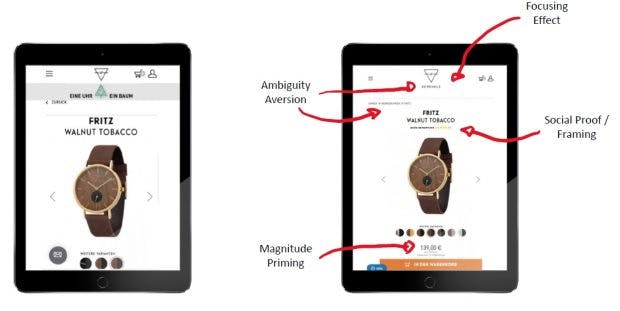
The logo : Kerbholz has a very simple logo. The recognition effect was only given to a limited extent. In the new website, the company name is under the logo. The measure should work against the so-called ambiguity aversion, it should bring about more clarity and unambiguity.

The breadcrumbs navigation : The old page didn’t have any, just a back button. This measure is also intended to ensure that the user remains in control and knows where he is.

The focus : a green fir tree appeared in the header of the old page, which was intended to point out the ecological approach behind Kerbholz: a tree is planted for every watch purchased. Assuming that the user already knows this on the product side, this eye-catcher acts as a distraction with the potential to be misunderstood.

Social proof : I mentioned trust above, and that is an extremely important factor, especially for new, small companies. The new Kerbholz page shows rating asterisks directly under the product name. The trigger is called social proof or framing.

Optical priority : The old page – probably a normal shop template – showed preview images with color variations under the clock. The price was not shown on the first screen. It is immediately visible on the new page and designed in such a way that it is perceived as particularly light.

The price was not visible in the first variant of the product pages. 

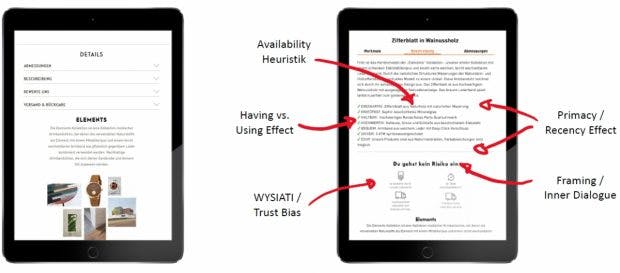
Availability heuristic : Explanations work best that are linked to something that practically everyone likes and knows from their everyday lives. In the case of notched wood, there are terms such as “natural wood” or “natural grain”. Our autopilot immediately saves such terms as positive.

Have vs. Benefit : If you can explain product functions or properties in daily use, the user immediately has the plastic feeling of closeness to the product. This is how the leather bracelet feels “soft”. The glass is “scratch-resistant” and “safe” against splashing water. It hardly matters whether the many features are actually all required by the user. “Many features” stands for “high quality”.

Doubly mocked : If there is a property that stands out in particular, it can be named twice in the description, if possible with different words. In the first bullet point, Kerbholz describes the clock made of “natural wood” and explains in the last point that you basically use natural materials. The message sits.

The repetition of the work with natural materials anchors this statement better with the customer.

And last but not least, it is important to take away the fear of a bad purchase from the user. Philipp Spreer speaks of inner dialogue and the new website anticipates: “You don’t take any risks”.

And that is clearly explained at the bottom of the product page: guarantee, right of return and free delivery at a glance. Spreer calls this WYSIATI : What you see is all there is. This element acts like a tranquilizer for the rational decision-making system and helps us to continue to make intuitive decisions.

Health

Kidney Transplantation – Chances and Risks of Living Donations

Frank Walter Steinmeier did it for his wife – he gave her a kidney. The number of living donors and those who survive thanks to such an organ has been growing for years. But donating life also harbors risks for the donor that should not be underestimated.

The regional express stops once an hour in Paulinenaue, a 1,500-inhabitant hamlet northwest of Berlin . You need a half hour train ride to the capital or a car here, where Brunhilde and Erich Ernst are now living their “second life”, as they say. The two of them also experienced firsthand what mobility means and what immobility means. After all, Erich Ernst, now 64, had progressive kidney failure tied to his armchair. Dialysis or transplantation was the alternative. But the waiting list for a donor organ was long. The couple decided to have a live transplant: in the summer of 2010, she donated one of her kidneys to him.

Endlessly long waiting lists

The subject of living donation has been gaining in importance for years, including on World Kidney Day (March 13). In 1991, only three percent of the kidneys transplanted came from living donors; in 2011 it was almost 28 percent. The reason is not only medical progress, but above all the low readiness of Germans to donate organs post-mortem, and which has recently continued to collapse: from 2012 to 2013 alone, the number of organ donors fell by a sixth to only 876. There were too many reports of bogus Allocation methods and manipulation of the waiting lists in some German clinics unsettled people.

In addition, there is the sensitive issue of brain death diagnostics. Recently, too, there were individual cases where the prescribed procedure for determining brain death had not been followed exactly. This is another reason why living donation, although formally subordinate to corpse donation as the second-best solution, is more important and, given the endlessly long waiting lists, promoted and recommended by many doctors. Family members, but also close friends, can donate for one another. Also because these organs are rejected less often and function better and longer on average than post-mortem donations, this is a real plus for most recipients.

Skepticism among kidney recipients

So for Erich Ernst: Today, three and a half years after the transplant, he is back in his armchair, but now voluntarily. He cheerfully picks up the coffee cup and tells about the fact that he can be on the road, riding a motorcycle. “I also have a mini job as a truck driver again.” The joy of being able to lead an almost normal life again can be seen in him. But with his wife’s decision, he initially had his problems.

“At the beginning I would have preferred to wait to see if there was still an organ from the donor list,” he says. He was worried about his wife – and also about their daughter. “If something had happened to my wife and me during the operation.” But dialysis, the other option, would have meant a trip to Berlin to the dialysis center three times a week. “Neither of us wanted that,” says Brunhilde Ernst energetically and lovingly nudges her husband. “No, we wanted to have the good life a little longer.” But the path to living donation posed a number of hurdles for the couple.

Living donation – danger for the donor?

Organ donation scandal in Göttingen

In the case of the Ernsts, a process of several months for living donations is set in motion: preliminary medical examinations and health checks, blood group comparisons, consultations with doctors and psychologists, and finally the mandatory visit to the ethics committee, which has to rule out the fact that commercial interests are involved. “I was asked about my motivation and was told so often that in the end I could hardly hear it,” says Brunhilde Ernst. On June 15, 2010, the two of them came under the knife in parallel. “When I was pushed out, I shouted to my husband: If everything goes well, we’ll go on a cruise.”

The two are lucky. The operation succeeds and the new kidney works promptly. But while Erich Ernst recovers quickly, his otherwise agile wife feels as if the plug has been pulled out of her. “I was very, very tired and limp. The doctors had already announced this to me, and that’s how it was: I just sat in the garden chair all summer, nothing more was possible.” Only after a joint rehab in autumn does she slowly regain strength. “I’m fine today,” she says.

“Cannibalized and exploited”

But things don’t always run so smoothly. Ralf Zietz from Morsum near Bremen donated a kidney to his seriously ill wife in the summer of 2010 and is still suffering from the consequences today. Chronic exhaustion, difficulty concentrating, and forgetfulness make it difficult for him to continue doing his job. The self-employed entrepreneur and sole earner can now only work part-time. He sees himself as a victim of a lack of medical education. “During these conversations, we only talked about the usual risks of an operation, possibly scarring problems or high blood pressure.” However, he was left in the dark that weakness and exhaustion can also be permanent. “With what I know today, I wouldn’t have the operation done again.”

While his wife is clearly better again, Zietz does not get out of the postoperative low. “I felt exploited and exploited,” he describes in an ARD film. Even today he still seems emotionally badly affected by the loss of his performance. Together with other people affected, he founded a self-help group and has since been campaigning for more information about the possible side effects of living donation. In several places in Germany, those affected have already filed lawsuits against the transplant centers – due to insufficient information.

More education for living donors

Zietz estimates the proportion of living donors who permanently suffer from the consequences of chronic fatigue due to their inadequate kidney function at around ten percent. He cites a Swiss study, which, however, has not been published in full. Zietz and his colleagues oppose the fact that their complaints are often not viewed as a neurological but a psychological illness – and in the worst case without any right to compensation.

“It is undisputed that the fatigue syndrome (chronic exhaustion syndrome) also occurs in donors, but it also occurs in healthy people. There are no serious studies that show a higher incidence in donors,” says Professor Uwe Heemann from the university hospital Munich and Chairman of the Living Donation Foundation. It is similar with depression. “Especially when living donations are unsuccessful and the organ is rejected, it can lead to depressive moods.” So far, there has been no evidence of an increased risk compared to the normal population.

The donor’s fate is unpredictable

Cool box for donor organs

What Heemann sees as well as the community of interests around Zietz are problems with insurance. “The new transplant law has brought us a big step forward in terms of donor protection, but there are still questions about its concrete implementation. Are chronic fatigue or high blood pressure a possible, foreseeable consequence? And: does the accident insurance pay? Not?”

Brunhilde Ernst has had similar experiences. “I always mess with my health insurance company – for example when they don’t want to reimburse the travel expenses to Berlin for my aftercare because the clerks don’t know about the new law.” Ernst also came to the conclusion from her experiences that it makes sense to exchange ideas with those affected and to support them – she is networked nationwide in a self-help group. “At the time I would have liked to be able to speak to one or the other donor beforehand and hear about their experiences. Many now turn to us when they are in the decision-making phase.”

Living Donation – A Moral Question?

The Berlin psychologist Merve Winter is also interested in this phase – from a professional point of view. She assesses possible donors and accompanies them in the decision-making process at a university clinic. “There is definitely a moral imperative to living donations. And women often comply particularly quickly,” she sums up. In fact, 60 percent of living donors in Germany are women. 

Winter notes that not all potential donors are really clear about their motives. Feelings of guilt, misunderstood altruism, the desire to generate gratitude in the recipient – a lot can play a role here. “In addition to the many positive aspects that it brings with it, living organ donation is still a psychological and physical challenge and an unreasonable burden for those affected, especially for the donors,” emphasizes Winter in a study. She therefore advocates giving ambivalent feelings more space in advance and not simply suppressing them.

The transplant doctor Andreas Pascher from the Virchow-Klinikum of the Berlin Charité knows this ambivalent attitude of many potential donors, who are torn between fears and the desire to help. “About a tenth of those willing to donate are turned down for such psychosocial reasons,” he says. A study on the progress of living liver donations, co-authored by Pascher, sums up: “Most living liver donations show a positive postoperative course.” However, the decision-making process prior to the intervention should not be accelerated and the medical follow-up care of the donors should be supplemented by discussions. 

“I was terrified for him”

As the recipient of a partial liver donation from her father, Claudia Schneider from the Heilbronn area also experienced this emotional rollercoaster ride. “I was terrified for him and at first didn’t want to accept the donation. But he said: ‘If I don’t help you now and you die, then I can no longer live afterwards.’ He made his will and clarified everything. But when I woke up from the operating room everything went well. Even if my father had problems with his scar for a long time – today his liver has completely grown back, he is healthy. And our relationship is still more intimate than before. ” She laughs happily. “I stroke my new liver every day. This is something really big for me.” Nevertheless, she would not recommend such a step to anyone who asks her for advice. 

Claudia Schneider has just celebrated her milestone birthday at the age of 42 – her 10th with a new liver. The Zietz family fights their way back to life. And the Ernsts from Paulinenaue? They went on their big cruise.

Health

How high is your risk of addiction?

Pills, alcohol, chocolate, shopping, betting, sports, sex or drugs – test whether you are at risk of addiction.

Addiction doesn’t just begin with a glass of beer in the evening or a regular cigarette. Those who cannot resist certain pleasures and even increase the dose gradually often gradually builds up an addiction. Addictive substances not only include illegal drugs, alcohol , nicotine or tablets. Non-substance-related addictions that affect behavior also play a role, such as uncontrolled shopping or eating, excessive exercise, sex or gambling. They can change personality, make you mentally and physically ill. Answer the following questions and find out more about your individual addiction risk.

Note: Please keep in mind that this is only a short test and cannot replace a medical diagnosis. Not all of the listed signs have to be symptoms of an addiction risk. But if you suspect that you are at risk of addiction, you should definitely consult a doctor / psychologist.

Technical advice: Dr. med. Dr. phil. Dr. rer. pole. Felix Tretter, chief physician in the addiction department at the Haar district hospital, and the German headquarters for addiction issues DHS, Hamm

Health

How psychotherapies work – and what side effects threaten

Depression, bulimia, addictions – different therapies are useful depending on the illness. In most cases, they will help in a short time. But like any treatment, psychotherapy also carries the risk of side effects.

There are three broad groups of disorders that are also the most common reasons for going to a psychotherapist: first, anxiety, second, depression, and third, addictions. To treat such disorders, psychotherapies have proven to be effective and promising. Eating disorders, sexual dysfunction, schizophrenia and bipolar disorders are sometimes more difficult to treat, says Jürgen Margraf, President of the German Society for Psychology. V. (DGPs). “For patients with schizophrenia or bipolar disorder, medication in combination with psychotherapy can therefore be useful.”

What happens in the therapy session

If someone seeks a psychotherapist, they will have the problem explained to them in an initial consultation. Within a maximum of five test sessions, the patient and therapist can then find out whether “the chemistry is right” between them. During these preliminary discussions, the therapist will make a diagnosis and explain whether treatment is necessary. He then submits an application to the cash registers. The approval for psychotherapy then also includes the number of hours. Only then does the therapy really begin. The scope of treatment depends on the mental illness and the severity of the disorder. In behavior therapy, short therapy lasting a total of 25 hours is usually sufficient.

“The health insurance companies take on two forms of therapy, behavioral therapy and psychodynamic therapies, including psychoanalysis,” says Margraf. “These forms of therapy have been scientifically recognized for a long time.” The regulations of the private insurance companies are different, so that those with private insurance should ask directly. The statutory health insurances only pay 100 percent of the costs if the therapist has a license to practice medicine and diagnoses a mental disorder with an illness value. These disorders are for example phobias, panic attacks, depression or compulsions. The therapist makes the diagnosis in the trial sessions.

Success rate is 80 percent

Behavioral therapy is the method of choice, says Margraf, especially for anxiety and depression – and thus for the most common disorders. In the case of anorexia and chronic pain, on the other hand, behavior therapy is generally less successful. Behavioral therapy focuses on current problems, but also on current strengths, and tries to change behavior. It is about how patients classify and evaluate information. The aim is to reinterpret situations with the help of the therapist and to practice healthier behavior. The motto here: Everything that has been learned can be unlearned again. Behavioral therapists do not want to look into the past, into childhood – but into the future. “The success rates are good.

The psychodynamic approaches go back to Freud and his students. They assume that the current problem is based on repressed feelings and memories. Using dream interpretations or free associations, the patient should get access to these emotions. “The symptom is traced back to a conflict from the past.”

Other approaches such as systemic therapy, body and art therapies are not (yet) adopted by the health insurances, but they achieve success in many cases. Especially as a supplement in holistic therapy concepts.

Opportunities and dangers in therapy

Whether a therapy is promising or not also depends on the patient’s “gut feeling” during the trial sessions. After all, it is important that those affected have enough trust in the therapist to reveal their inner being to him.

Underestimated side effects and effects in psychotherapy

In individual cases, the patient’s condition can worsen at the beginning of therapy because, for example, repressed experiences and feelings come to the surface and then make people wonder. Other undesirable effects are financial exploitation of the patient, for example by artificially prolonging the therapy. In general, there is always the risk in the patient-therapist relationship that a dependency will arise and that this will be exploited by the therapist. “There are also cases of border crossing and even sexual assault,” says Margraf. Especially in body-oriented settings, the risk of such attacks is higher. Above all, charismatic and renowned personalities are prone to abuse their power and status.

Other negative effects of psychotherapy are less easy to measure. “When therapists give false hopes, do not agree on goals or interfere too much in the patient’s life, it is difficult to grasp,” says the psychologist. He describes it as a “classic” that many therapists identify the couple relationship as part of the problem, even though they have only heard one side. This often leads to a crisis in the partnership that would not have been necessary. “Some therapists also impose their own norms and values ​​on the patient.”

Mental health problems in children are underestimated

Despite sometimes hair-raising side effects, Margraf emphasizes: “Essentially and in the vast majority of cases, psychotherapy is good.” The only downer: it is a long way to go before this help reaches all affected people.

Children in particular are still too often neglected with their mental health problems. It was worthwhile to intervene early to prevent serious disruptions from occurring in the first place. The problem: While aggressive and hyperactive children move into the center of attention, depressed or anxious boys and girls often fail. “In a society with fewer and fewer children, there is a lack of siblings and playmates. This will be a big issue for children’s mental health in the future. “

Health

Always angry? Maybe you have toxoplasmosis

If you meet a traffic hooligan on the street who is pushing, scolding or even showing the middle finger – then he could be suffering from toxoplasmosis. The infection can actually cause outbursts of anger. Fortunately, not everyone infected develops aggression, otherwise there would be many more rowdies on the streets.

  • The pathogen Toxoplasma gondii attacks the nerve tissue in the brain.
  • This apparently leads to outbursts of anger in infected people.
  • Animal studies have shown that the parasite can actually control mice remotely.

A traffic hooligan, pushing, honking or scolding may not be able to do anything for his outrageous behavior – his brain could simply be controlled by others. Parasites of the species Toxoplasma gondii may have nested in it and are now causing neuronal chaos.

At least this is what a study carried out by psychiatrists at the University of Chicago suggests on patients who have been noticed by aggressive behavior and sudden outbursts of anger. The work appears in the journal “Journal of Clinical Psychiatry”.

Twice as many outbursts of anger among infected people

It was found that people who had several seizures in succession were more than twice as likely to be infected by the pathogen as healthy people who had no psychiatric diagnosis.

The unicellular organism, one of the so-called protozoa, occurs worldwide and is widespread in the population. According to the Berlin Robert Koch Institute, 50 percent of Germans carry it in their bodies or have at least come into contact with it.

In the group of people over 50, the level of contamination is around 70 percent. It affects up to 16 million people in the United States, more than the country’s schizophrenia sufferers and those with bipolar disorder combined.

The pathogen usually affects cats

The actual host of the parasite is cats , which excrete it with their feces. People can get infected through smear infections, but also through contaminated water and the consumption of raw meat.

The infection usually proceeds without symptoms, but occasionally toxoplasmosis occurs, which is accompanied by flu-like symptoms. If women become infected during pregnancy, there is a risk of miscarriage.

Toxoplasma gondii affects the nervous tissue

Previous research found that Toxoplasma gondii affects nerve tissue in the brain and is associated with diseases such as schizophrenia , bipolar disorder, and suicidal ideation.

The Chicago scientists built on this. They examined 358 US citizens as test persons, one third of whom suffered from “pathological irascibility” (the technical term for the sudden attacks of aggression), another third from other mental disorders. The latter served as a control group to differentiate the irascibility from other ailments. The test subjects in the remaining third were mentally healthy.

In fact, blood analyzes and other tests showed that twice as many irascible patients had come into contact with the parasite than healthy subjects. The rates of the mentally ill group lay in between.

Sick people were much more aggressive

But the impulse control disorder – it was measured according to a point system – was much more pronounced in the irascible than in the other two groups, whose subjects hardly differed.

Overall, test subjects who tested positive in all groups were found to be significantly more aggressive and impulsive than those with a negative test result.

“Our work suggests that latent infections with Toxoplasma gondii can change brain chemistry in such a way that the likelihood of aggressive behavior increases,” explains study leader Emil Coccaro. “But we don’t know whether this connection is causal, because not everyone with a positive test result gets tantrums.”

Further studies are needed to find out. “A correlation is not yet a cause, above all it cannot be deduced from the fact that people should get rid of their cats,” adds Coccaro’s colleague Royce Lee, a co-author of the study. “We don’t yet understand the underlying mechanisms.”

This could be an inflammatory response in the body’s response to the infection, or it could be a direct modulation of the brain by the parasite. But a paradoxical reversal of the cause is also conceivable, Lee continues: Aggressive people could keep more cats or eat raw meat.

Further investigations will follow

Now the Chicago researchers want to investigate the connection between toxoplasmosis, aggressive behavior and pathological irascibility. They hope that this will provide further knowledge about the condition that will lead to new diagnostic and therapeutic methods. “We have to conduct experimental studies to see whether treating a latent infection reduces aggressiveness,” says lead author Coccaro. “Then it might prove sensible to fight toxoplasmosis first in irascible patients.”   

Several studies in recent years have shown that Toxoplasma gondii can actually change behavior.

The pathogen reprograms mouse brains

If the parasite attacks mice, it makes them forget their fear of cats so that they no longer flee from their enemy. Occasionally, infected rodents even run up to cats, attracted by the smell of their urine.

It seems like the mice are about to be eaten. This is exactly what the parasite wants to achieve, because it can reproduce sexually only in the cat’s intestine, so rodents are only intermediate hosts for it.

In 2015, scientists at the Indiana School of Medicine discovered how the pathogen reprograms the mouse brain: Apparently it modifies certain brain cells, namely the so-called star cells (astrocytes).

They help to supply the nerve cells with nutrients from the blood and generally maintain the physiological balance in the brain. In infected mice, certain proteins in the astrocytes were changed compared to the cells of healthy animals.

The task now is to find out whether this mechanism can change not only the character of mice, but also that of humans.